Thursday, March 6, 2014

San Miguel Memories

Colorful San Miguel.  Streets, shops, decorative arts, Katrina shop, an outdoor cafe,
Elissa and friend Gay; with Don Quijote; in new t-shirt; beautiful carvings, wall painting 

I love the colors!"
"Oh, look, another VW bug.  I've never seen so many in one place."  Elissa started taking pix of the old cars, once made in Mexico, still chugging along the cobble-stoned streets.
"Wow, what beautiful doors."

It was daughter Elissa's first trip to San Miguel de Allende, Mexico, and she loved everything she saw and experienced, not to mention the perfect weather.  All the sights and sounds; the hilly ancient streets, the architecture, arts and crafts,shops and restaurants, and "the best margaritas, just like Aunt Andy said!"
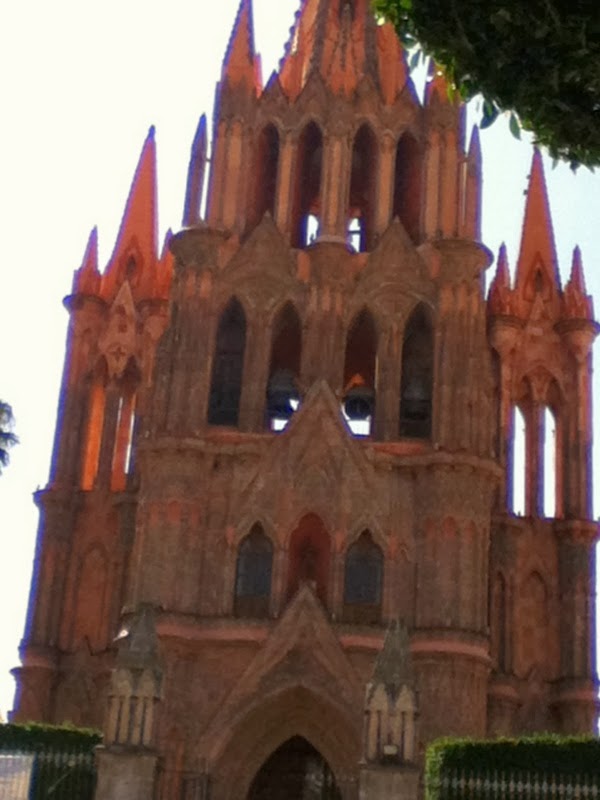
The Parroquia
We walked every day from El Jardin de Don Quijote, our B&B near the famed Instituto de Allende, to or through the tree-shaded Jardin, the central public square.  The sight of the iconic Parroquia de San Miguel Arcangel, a pink sandstone neo-gothic church, bowled her over, as it did me and most every other visitor the first time we saw it, and ever since.  The church bells chimed, as if in appreciation.

Always aglow and striking, it towers over the Jardin and dominates the skyline. "Follow the Parroquia and you can't get lost," I assured her. "Well, I don't have to pay much attention to directions, with my good tour guide!"  But Elissa got the geography of the town down pretty well, almost as much as her menu instructions (no gluton, no dairy).

On the food front,where there could have been some misunderstanding, there was no trouble.  No wheat, no milk, no butter, no cheese, no dairy. She gave her list, in Spanish, and waiters were happy to oblige, talk to the cook, bring out the cook, explain the food.  "I have it down," she'd say, after her stream of excellent Spanish.  We had some great meals, at Hecho en Mexico, Cafe Jardin (with some nice jazz), Cafe Monet (where we heard fabulous pianist Alejandro Mora), and Mexifran (where we plied the guitarist with tequila and had some great fun!).  There's lots of ways to cook chicken, steak and fish, with corn torilla and quacamole, steamed veggies and various fruity sauces, Elissa found out.  Food and music! "Viva Mexico!"

Talavera pottery at the Artesenias Mercado.
"Great place to shop, too"  We stopped in just about every shop we passed as we strolled the town, many in gorgeous mansions that were once private haciendas, topped off with a trip to the Artesenias Mercado (Artisans Market).  The mercado teems with vendors' stalls selling everything from tin frames and mirrrors, to puppets and toys, jewelry, rugs, and ceramics (called Talavera), hand made and hand crafted.

We took in historic sites, went into churches, visited the Biblioteca, galleries, Bellas Artes and the Instituto. The art is exquisite, from pre-historic, to colonial, to contemporary. The murals are fantastic. At the Instituto, we happened upon a great textile exhibit by weaver Elizabeth Starcevic, as well as the works of one of Mexico's (and my) favorite artists, David Leonardo. We had a nice chat with David's agent, who explained the difference between "mamacita," which Elissa calls me, and "mamita," which he calls his mom.  I told her both were acceptable, one being a voluptuous sexy woman (ooh-la-la), and the other a beloved mama, Juan said.

We happened by a brand new exhibit of Polish posters, of all things, as we walked down Zacateros to Mesa Grande, the wifi cafe. The posters were collected by Dr. Martin Rosenberg, "the largest and most complete selection of pre-war and vintage Polish cultural posters in existence."  The Rosenberg Collection is huge; the posters are noted for their originality, artistry, brilliance.  "The exceptional Polish poster is...a work of art rather than a conventional advertising placard," notes Elena Miller, a retired Curator of Posters at the Library of Congress in Washington, DC.  Their bold designs and bright colors fit into San Miguel.

Polish graphic art posters
"Serendipity," Elissa the graphic artists noted, "to come across such a fabulous graphic art collection."  Dr. Rosenberg himself was there to greet us when we walked in, drawn in by the beauty and diversity of the posters.  In Poland, he noted, the graphic arts are honored.  Elissa liked hearing that. The subjects were fantastic too, theater, music, opera, jazz, the Circus, sports and travel, politics and dance.

"Why are the posters here? Why did you open a gallery in San Miguel? she asked him.  "Because I moved here after retiring, and brought them with me!" Thousands upon thousands of them. Lucky for San Miguel.
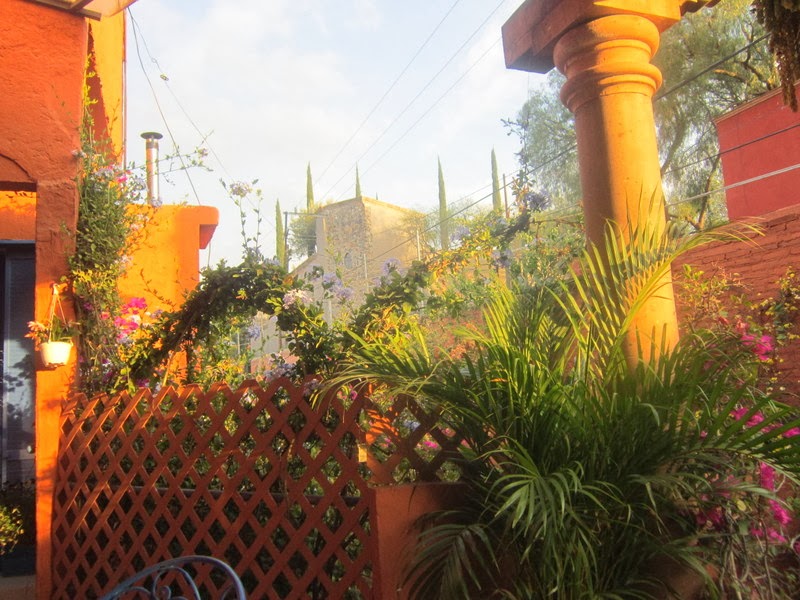

"You never know what you might find behind a San Miguel door," I told Elissa.  We peeked behind lots of them, and walked into many former homes turned into shops and galleries: complex columns, glorious courtyards and fountains, super high ceilings carved, tiled, curved and beamed, and extravagantly tiled walls, doorways and floors.  "We're not in the US anymore," Elissa smiled, as she embraced the beauty. "Definitely in Mexico!"

Elissa talked to lots of artisans and shopkeepers.  Among the most interesting was Juan at the Katrina gallery, which is packed with those colorful skeleton dolls associated with the Mexican "Day of the Dead." Mexicans have a special relationship with death, as with life; nowhere is death more openly acknowledged and celebrated as it is there.  Elissa selected a beautiful ceramic doll for her daughter Julia, and Juan regaled us with her history as he carefully wrapped her.  The history goes back to the late-nineteenth century in Europe and Spain and was popularized in Mexico by Diego Rivera's famous mural "Dream of a Sunday Afternoon along Central Alameda."  The mural beautified a large government building in central Mexico City, which was destroyed by a horrendous hurricane in 1985. It means something that the mural survived, but the building did not. From Rivera's perspective, the Katrina, as she is called in Mexico, is related to an Aztec tradition, in which she is "Keeper of Bones" in the underworld and presides over festivals honoring the dead.
Doors and decorations;  tapestry exhibit at  Instituto; Church of San Francisco; balloons and toys in Jardin, mountains in background; carving on a corner building. 
"Seems to me like the Mexicans took a tradition, blended its Spanish and indigenous heritage, and made it their own," I said to Elissa.  "Yes, just like they did with the Catholic religion and the Catholic church," she noted. "Made it their own."  That's San Miguel and Mexico in a nutshell, I thought.

"Anything else you want to see?" I asked on our last day.  "I just want to get an 'I Love Mexico' T-shirt," she said with a laugh.  And sure enough, that's what we did!

Friday, December 20, 2013

Florida Heaven Before Home for the Holidays

The beach (near the historic pink Don Cesar), a white bird of paradise, with friends,
 some downtown decorations, full moon over palm, visit to Gulfport and iconic Casino.

It was great being back in St. Petersburg, Florida, where I had lived for 10 years before going to Ukraine with the Peace Corps and then moving back to the Toledo area.  I stayed with friend Sandie;  visited a former neighbor, 85-year-old Maria, still going strong; and also artist friend Sue and retired publisher Christopher, who helped publish my brother Loren's autobiography, An Asperger Journey. I couldn't do everything I wanted; time flew by.  I'll return next year, for sure!

Best was being in the downtown area, close to the Bay, on the waterfront, near museums, restaurants and shops. A dinner at The Moon, a favorite restaurant, was a special treat.  We ate out a lot, there are so many great choices and all in walking distance.  The holiday decorations along the waterfront are spectacular, and more so as the sun sets and a glorious full moon rises. The weather was perfect. The beach was wonderful.  Christopher reminded me that the heat is never far away, but I remember the winter months--December, January, February, March--the best time of the year in the Tampa Bay area. While snow and ice covered Toledo and places North, we basked in the glow of a Florida winter. No wonder those Allegiant airways flights between Toledo and St. Pete are always filled!

Now I'm back home in Sylvania, negotiating colder temperatures and snow. But I have my Florida memories to keep me warm.  And the joys of a family holiday in the wings.

Friday, October 11, 2013

California Dreamin"


Santa Rosa Sunset

Lynmar Estates Winery in Sebastopol with Suzanne: vineyards, glorious gardens, gourmet lunch.
The hills and fields of lush vineyards, golden wheat, and changing foliage with a dash of oranges and reds here and there gleamed and screamed California.  Going up and down the coast and inland from Oakland to Santa Rosa, through Berkeley and the northern San Francisco area, is stunning in October. The colors and light are as beautiful as anywhere in the world. Your soul soars with the eagles. 

At Casa de Rod  in Santa Rosa, with PCV friend and master chef Suzanne.


Jack London's Wolf House ruins, park, burial ground, walking paths.
 Yep, that's me, top middle photo, in front of a mural pointing toward the massive ruins
 in what PCV friends Ilse and Carl call my ubiquitous pose!

A statue of St. Francis welcomes us to St. Francis Winery,
 surrounded by mountains,
and full of animals there for a special blessing.
Suzanne's cooking was food for the body and the soul.  She shares the home of her friend Rod in Santa Rosa; the chef in residence he calls her.  Suz and I met in Ukraine, where she put her creativity to great use in a small town in western Ukraine while I put one foot in front of the other in far-eastern Ukraine.  The distance was vast, geographically and culturally, but it was fun to share our experiences, then and now.

She is totally at home in Santa Rosa and the Sonoma Valley, a California girl born and bred. She's lived in the North and the South, near the ocean, in the mountains, in the valleys. Lucky for me! She shared the countryside she love, the winding mountain roads, the farms and vineyards of Sonoma county and such special places as Lynmar Estates Winery in Sebastopol for a gourmet lunch with their fine house wine; Wolf House in Glen Ellen, novelist Jack London's stone mansion ruins burnt down as it was being completed, and his burial ground on the Beauty Ranch Trail; the historic town of Sonoma itself, built elegantly around a square; St. Francis Winery, which held a blessing of the animals (over 100 of them, of every variety, mostly but not only dogs).


Doris and I around her place and UC-Berkeley.

From Santa Rose we made our way down to Marin to meet friend Doris, from my old 
Toledo days, and share a delicious Thai lunch.  Then  Doris and I drove down to Berkeley, the storied  home of the University of California. It's a great college town, full of not only student housing, services and gathering places, but elegant old homes, nice walkways and gardens, lots of bookstores, shops and restaurants, some remnants of Hippie and anti-war days, and the grand white marble buildings of the University itself.  Lunch at a famous pizza place, Cheese Board Pizza Cooperative, topped off the grand tour of UC-Berkeley, all polished off with many long talks between two old friends whose bond neither time nor distance can sever.

 The historic town of Sonoma, old and new, native American, Mexican (General Vallejos was a founder), and Anglos, a beautiful natural and built environment around a central plaza, a Mexican-like square.
A small part of the grand UC-Berkeley campus, the classical library, a sculpture, statue of Mark Twain at entrance to the elegant Library reading room, and the famous Cheese Board Pizza Collective,
where we had lunch.

Thursday, August 8, 2013

Cruising down the Maumee River with Steve Pollock: Outdoors Advocate


Steve Pollick with a few slides at Lourdes' Lifelong Learning program.
.
Steve Pollick may be retired from the Toledo Blade, where he was Outdoors Editor for over 30 years, but he's not retired from public life, including public education about the natural environment of Northwest Ohio and Southeastern Michigan. He knows this environment intimately; has written thousands of columns about it; and continues to explore it.

Pollick shared his love of the Maumee River Watershed on Lake Erie, at 6,600 square mile the largest of all the Great Lakes watersheds, at a talk to Lourdes University's ever-popular Lifelong Learning program on August 16, the inaugural program of the 2013/14 season.

Pollick took us along on his June 2011 canoe trip down the Maumee River from Fort Wayne to Toledo, with a slide show and talk about the natural habitat, the exuberant wildlife, the dangers, the beauty. What an adventure!

"When you're down on the river, way down from the land, the highways, farmland and bridges, you feel the wilderness."

He helped us feel it, too!  He called his talk "Beauty and the Beast."  He started with the "beasts," the current dangers to the river, mostly the spread of green algae, a thick, slimy mess, and proliferation of Asian carp, which can grow into huge feeders especially in western Lake Erie.  He followed with slides of the beauty of the river. He ended by reminding us we have a choice: Beauty, or the Beasts?

Steve Pollick photo, Sunset over the Maumee. Its beauty is in our hands,
he reminds us.

Sunday, July 28, 2013

Nantucket Memories


The view from Hinckley Lane Cliff Beach.
My daughter Michelle and her four kids (ages 18, 16, 11, and almost 2), and two special friends as well, are on their way to Nantucket. They're packed into a large van overflowing with excited passengers and lots of luggage. Imagine seven people surrounded by suitcases, beach stuff and food supplies, every electronic gadget available, and tons of things for an 18-month old.  Imagine an 18-hour or more ride to Hyannis from Sylvania, due east through Ohio, Pennsylvania, New York and parts of Connecticut and Rhode Island over to Cape Cod, Massachusetts.   We used to do this every summer, plus we took along our huge Norwegian Elkhound Tryg (after Trygvie Lee, the first head of the United Nations).  Of course it's all worth it, once you get there. 

I decided not to go this year, and to plan a trip to California in the fall  to see old Toledo and Peace Corps friends.  But I'll miss Nantucket: relaxing on the ferry over from Hyannis; catching the church steeples on the horizon as we approach the island, "the Grey Lady," 30 miles out to sea.; docking in the busy harbour; driving up Cliff Road to the cottage on Hinckley Lane, passing grey shingled houses surrounded by deep blue hydrangea and wild roses. 


Last summer, July 2012.
Just thinking about it takes me back. We summered there when the kids were growing up. Vacation and family time mixed together. Still, to this day, I smell the salt air, the fresh breezes over the moors, the honeysuckle and bayberry along the lane to the beach. I hear the sound of waves crashing on the shore at Surfside and the foghorns at night.  I see the ocean from the top of the cliffs, white sails in the distance, the Jetties beach to the East, Madaket to the West.  A beautiful watercolor scene, blue and pastel, serene. I see the moon setting over the ocean, an earthly phenomenon we would rush to see after dinner, running down to the beach. 

"Nantucket's in my blood," Michelle says, "and now it's in my kids' blood, too."  She wanted to make sure of that, and she has. Nantucket memories.  They fill up your senses, live in your soul.    


Friday, July 19, 2013

Embracing Community at Asbury Grove

Gloucester, the famed fishing village where the ship in "The Perfect Storm" went to sea and never came back.
Monument to Fishermen, upper right, which is surrounded by a granite wall etched with the names of those who
 have died at sea. Sailor Stan's Cafe in the famous Rocky Neck Art Colony, and a few artists' cottages (lower right). 
 With Ilse, Carl and Bea at our  "farewell"  all-you-can-eat steak dinner at old Weathervane Tavern
 in Hamilton (lower left). "Okay," Carl called out, "hands outstretched!"
I enjoyed a slice of folksy Americana last week at Asbury Grove in Hamilton, MA, about 20 miles north of Boston.  Asbury Grove was founded by the Methodist church in 1859 as a summer camp meeting ground, part of the religious revivals that flourished around the 1850s to the turn of the 20th century. Religious groups of various denominations still "camp" at the 85-acre site, but today it is mostly a community of  privately owned rustic summer cottages for people from up and down the East coast and beyond. There's also a growing number of year-round residences.  The land is owned by the Methodist church.

Peace Corps friends Ilse and Carl invited me to their cottage in "the Grove," as it is affectionately called by the people who summer there, and I took them up on the invitation.  So did our PC friend Jud, who now lives in Washington, DC.  What a great place for a reunion of RPCVs who shared time in Ukraine!

Ilse and Carl, adventurers and world travelers, have summered at Asbury Grove for over 30 years."I fell in love with it the minute I saw it," Carl says. Over the years they've fixed up their cottage, modernized inside, added a great screened-in porch, and plan to paint the porch floor (deep aqua) and trim (eggplant purple), add "gingerbread" architectural features around the outside, and put in a garden. That cottage, in short, keeps them busy. Or, I should say it keeps Carl busy. They love it. And now their children and grandchildren do too.

Carl and Ilse's cottage
In fact many of the friends and neighbors we met on the winding paths of the Grove, all friendly and welcoming, have summered here for generations. They waved hello or stopped in for tea or wine and great conversation on every subject imaginable, politics not excluded. Roger the photographer took photos. We met other neighbors tending their gardens; admired the latest updates to a cottage; shared concerns for preserving authenticity.  We joined friends for a hearty meal at the dining hall and for a Zydeco band concert at the Tabernacle, the oldest tabernacle in America. The band called themselves the "Squeezebox Stompers," and oh boy, did they get us dancing!  Among it's tall pine trees and exuberant bright blue hydrangea, Asbury Grove also features an olympian-size pool and other recreational amenities, great for families, campers, and kids of all ages.

A precious sense of community predominates.   Fellowship, bonds of friendship, the ties that bind. It's easy to feel as if you belong, even if you are a stranger.

Residents proudly note that Asbury Grove is now listed in the National Register of Historic Places. As part of the application process, residents researched the architecture of the cottages--Victorian Gothic, Italianate, Vernacular--and the history of the community. It was a labor of love, with many volunteer hours donated.  The folks of the Grove (including Carl) continue to do research, collect records, photos and memorabilia, and work with top-notch archivists, who are also residents, to preserve and digitize their collections (I think at Boston University) for future generations.  A "wholesome" place, as Jud put it.  A community of kindred spirits, rare in this day and age.

Linda's cottage. A creative soul, a producer of plays and special events,
 she painted a spirited dragon all around it. 
On top of sharing a great community, Ilse and Carl, generous and accommodating hosts, took Jud and me to tour nearby towns along the beautiful North Cape area:  Ipswich, Halibut Point, Rockport, Newburyport, Gloucester and the Rocky Neck Art Colony, and historic sites like the Choate bridge (1764) and the General Patton house, soon to be a museum. We browsed at antique shops, souvenir stores, and various galleries; admired ocean fronts, boats, ships and lighthouses; reminisced about our PC days in Ukraine; shared fantastic meals and camaraderie.  Best of all, we savored a kinship that crosses time and space, and made many new memories.  Historic Americana all the way. A feast for the spirit, food for the soul.
Halibut Point, a beautiful site, where Carl, Ilse and friends picnic on the large granite boulders.
Powerful storms have shifted their configuration over time, an amazing phenomenon. A lovely path
leads to the rocky shore (lower right corner)
"Perhaps Loren's path," the ever-kind Jud says to me. 

On to colorful Rockport, once known for its timber (for boatmaking), fishing, and granite quarries like Halibut point.


Choate Bridge 1764 in Ipswich (upper left), then over to lovely Newburyport.  Carl on the waterfront.
Great dinner (clams, scallops and shrimp) at famed Clam Box on way back to Asbury Grove.
There's ALWAYS a line to get in. General Patton's homesite and future museum (right corner).

Monday, July 8, 2013

Egypt Emerging

ramyabdeljabbar.worppress.com on yahoo
The revolution continues.  Egypt's democracy is emerging.  But it won't be easy. It won't be easy because the Islamists won't accept the will of the people.

Morsi could have stepped up to Mandela status and listened.  He could have included more voices in his regime. He could have vetted the new constitution with people outside of the Muslim Brotherhood.  The Muslim Brotherhood could have agreed to engage in a democratic process.  Show in practice that they know what democracy means. They could have accepted other points of view, rather than talking about democracy and acting like tyrants.  Now they are inciting violence, begging for violence, killing Christians and other minorities who disagree with them, acting more like terrorists than citizens, keeping Egypt in turmoil rather than promoting a peaceful transition that the majority wants.  Really, I don't think they care about what the majority want.

Can the Islamists swallow their anger, get out of revenge mode, and step up, for the good of the whole. Have they ever done this?  We can acknowledge the critical role they played in ousting Mubarek from power, a grassroots uprising.  But did they have to install an Islamist Mubarek-type government after all that?  Did they have to turn the Arab Spring on its head? Couldn't they have been among the first Islamist government to stand for a real democracy, a secular state with separation of church and state, open and tolerant? That's the real Egypt and they know that.

I am hooked on what's happening in Egypt because I love the country and its people.  The Egyptian ambassador, Mohammed Tawfit, has told the true story: the ouster of Morsi was not a coup: it is a correction on Egypt's path to democracy begun in the Arab spring.

When Morsi was elected, hope ran high.  Tawfit and many like him suppored Morsi, hoping he would get a new democratic government on track. Now THAT would have been a revolution!  Instead, Morsi did the opposite.  When you refuse to open up the government to other than Islamist voices, when  you call for jihad, and start calling opponents "infidels,"  you are not running a democratic government.  You are imposing a totalitarian Islamist government on the majority of the people who hoped for better and want a democracy.

The Muslim Brotherhood is showing it's true colors by inciting violence and refusing to participate in a new process.  They are talking democracy and acting like extremist religious nuts.  That's the worst aspect of this whole thing: the Islamists can't seem to rise up to expectations for a tolerant democracy that includes many voices.

So Egypt remains in crisis.  We all hope the interim president can hurry up and offer new elections and begin again the promise of the Arab Spring. When it comes to the Middle East, I always say "hope springs eternal."