Wednesday, August 25, 2010

Yevpatoria, Crimea


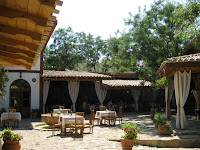
Street scenes, old town; Turkish restaurant; the Mosque; the Cathedral and lavish interior; Kainite Jewish memorial with prayer room and an engraved tablet.

Yevpatoria, or Evpatoria, is a very special place, like Bakchysaray. It's where the steppes meet the sea, as Barbara put it. No mountains here, but a rich history of different cultures that once made this fabulous Black Sea port their home. I have just learned about a brand new "Black Sea Studies" program at the International Hellenic University in Greece, testifying to the geo-political importance of the area, and after getting a glimpse of this ancient city I am tempted to sign up!

Barbara was a great guide. We wandered into the "old city," where Christian and Orthodox churches, a Muslim mosque, and a Kainite (Kenite) Jewish temple and monument exist near each other, towering over historic homes and restored buildings lovingly decorated and painted.

The Orthodox Cathedral, St. Nicholas, is an opulent building, lavishly decorated with paintings and icons, right up there with St. Mary's in Krakow and the Orthodox churches of Kyiv. Another church, proclaiming "Christ has Risen," stood amidst a lovely garden where Barbara and I sat on a bench and marveled at the sight. The 400-year-old Kahn mosque is elegant but I didn't put on the burka and head dressing necessary to go inside. Memories of Istanbul's Blue Mosque twirled around my head. We heard a Call to Prayer, however, as we toured the Kainite Jewish temple, a contemporary memorial to an ancient nomadic tribe of Turkish descent. I learned that this sect, which I knew nothing about, goes back to the time of Cain and Abel perhaps. It's mentioned in the Old Testament and was apparently spared from the horrors of the Holocaust, I'm not sure why. You walk under a beautiful grape arbor to get to the memorial, which features a prayer room and beautiful marble columns, medallians and tablets engraved with texts from the Torah.

The mixture of religious buildings, ancient homes and streets, and cultural artifacts in this relatively small area of Yevpatoria astonishes. I wanted to know more about how these different cultures and religions came and went, rose and fell. I wanted Loren nearby to tell me more. I think he would have felt at home here himself. I imagined Barbara, Loren and I, having lunch and tea outside at the lovely Turkish Restaurant Jeval.

Yevpartoria, Crimea, an international crossroads: Loren's soul might well reside here.

Yalta and Livadia Palace

Yalta waterfront; Livadia
palace; interiors; vistas.


Going to Yalta from Simferopol on the bus is half the fun and excitement.
Heading into the mountains of southern Crimea is a dream, and I thought for some of the time that we were driving along Route 1 in California. The mountains rose and the sea emerged, the legendary Black sea, a crossroads between East and West for centuries . Barbara said it was "like Yosemite meeting the ocean," it was that beautiful.

And then we arrived in Yalta, a beautiful Russian seaside resort town that has remained a Russian resort town. We walked along the tree-lined boardwalk and pepple (not sandy) beaches, past some Renaissance-like buildings that look like former palaces, lots of health resorts, shops, and souvenir stalls, a busy harbour filled with huge cruise ships from around the world, and sailboats and fishing boats on the shimmering sea's horizon. It was a clear blue-sky day and the whole scene looked like a water-color painting.

A highlight of our visit was seeing the Livadia Palace, where Roosevelt, Churchill and Stalin met to end world War II. It is a long white Renaissance-style palace with a beautiful portico entrance, floor to ceilingl windows, balconies that look out on incredible vistas, large elegant rooms and decorative arts.

The first floor of the palace features the state rooms where the three leaders met for the Yalta conference, including a state reception room surrounded with carved walnut wainscotting and a lovely Venetian glass chandelair floating down from a walnut carved ceiling. For breaks, these world leaders could stroll in anItalian courtyard, or meditate in the smaller but lovely Arabian coutyard decorated with magnificent tiles.

The second floor features the elegant royal rooms of the last Tzar of Russia and his family, all victims of the Communist revolution. A royal study, library, bedrooms, and the children's classroom overlook the most magnificent vistas of

nature, mountains and sea imaginable.

Yalta is sometimes called "The Pearl of Ukraine," but I didn't feel like I was in Ukraine when I was in Crimea. Everything about it is so different from eastern Ukraine, the mixture of pre-historic, Christian, Orthodox, Turkish, Russian, Tatar, and Islamic history, the prosperous looking seasdide towns, the ancient names and places of mixed ancestry.

I'm told the majority of people in Crimea remains firecely loyal to Russia, while the indigenous people, the Crimean Tatars, who were forcibly removed from their homeland by Stalin and the Soviets, view the Soviets as intruders and oppressors. The Crimean Tatars live with the pain of a well-organized Soviet army-enforced deportation on the evening of 18 May 1944. Some 47% of the rsesettled population died of disease and malnutrition during the deportation. Crimean Tatars are now returning to their homeland after over sixty years in exile, many from Uzbekistan and Turkey. Sometimes the tension is palpable, and sometimes it is lost in the beauty and serenity that engulfs Crimea.

Returning Crimean Tatars have lots of stories to tell. The pain of losing their land remains, along with fervent efforts to preserve their language and culture. Would an ordinary but ancient pair of forged iron tongs mean anything to most of us? Probably not. But to one family it is all that remains of parents, grandparents and other relatives forced to flee their homes in a hurry one dark night in 1944, grabbing whatever they could in a state of shock and panic, a pair a tongs, a symbol of the sorrow of forced removal from ancestral homes.

Crimea has a complex past and present under its magnificent exterior. But Yalta remains a shining star.

Sunday, August 22, 2010

Bakhchysaray and Chufut-Kale


Barbara at the caves; the cave city Chufat-Kale; the Khans' palace with minaret and entrance to small mosque; and the Uspensky monestary.


Bakchysaray, which means "garden palace" in Turkish, was once the capital of the powerful Crimean Khanate between the 15th and 18th centuries. After decades of tragic destruction
from both the Russian Tzars and then the Soviets, the town and its treasures are coming back to life.


The Khans' original palace survives, supposedly
because Catherine the Great thought it was
"romantic and sweet," which it is. The

palace was built by slaves under the direction of Ottoman, Persian and Italian architects. This would be a fantastic story to research and study. It's noted for its intricate designs and gates, its lovely mosque and minarets, its pretty harem, its wall paintings and decorations, and beautiful courtyard. The "Fountain of Tears," erected by master Omer in 1764 to honor his daughter, moved famous Russian poet A.S. Pushkin to write his poem "The Bakchyrsaray Fountain" in the 1820s.

Nearby is the lovely Uspensky Monestary, built into the rocks, probably by Byzantine monks in the 8th or 9th century. The gold-domed church, whitewashed and tiled, shines like a bright star on the hillside. The Soviets closed the church down, but it opened once again in 1993 and is maintained by local monks.

The most fantastic hike is through the old cave city of Chufat-Kale, fortified both by nature and man. It is a complex series of caves and structures (sheds, homes and barns) built into the limestone rock, which provided a fortress and refuge for different groups of migrants for hundreds of years. The views of the valley below are breathtaking. The guidebook Barbara has said it was first settled by Christian descendants of Samarian tribes, then around 1390s by the Crimean Tatars, and after the Tatars dispersed, by a dissident Jewish sect, the Kainite Turkish Jews, until about the mid-19th century. This sect of Judaism gave the mountain its current name, Chufut-Kale.

Wow, if these hills could talk. Scholars have tried to listen; lots of archeologists, for example, have explored the caves and tried to reconstruct their complex history. It's certainly a scholarly feast. But I think my brother Loren could tell me more than any guidebook or scholarly studies. He knew this history and I wish he were here to tell me.

Bakchysaray is a fascinating part of Crimea, and the planet, a place where old civilizations sought refuge and moved mountains, and modern generations are moved to understand them.

Saturday, August 21, 2010

Crimea, Tartars and Bakhchysaray

Barbara (with my luggage!) in front of the
Crimean Tartar Library; a lovely archway at the Library; a taste of Smferople.


I’m in Simferople, Crimea, visiting my PCV friend Barbara, who lives and works with the Crimean Tartar community. Simferople is a city of about 345,000, which feels huge coming from Starobilsk. Barbara lives in a neighborhod repopulated by returning Tartars who were kicked out of their Crimean homeland by Stalin in 1944. Here’s how she describes the community (www.crimeantartarlibrary.blogspot.com):

The Crimean Tatars are a Turkic Muslim people who inhabited the Crimean Peninsula—the southern land mass of Ukraine surrounded by the Black Sea and Sea of Asov—for over seven centuries. For three hundred years, from 1441 t

o 1783 when Crimea was annexed by Russia, the Crimean Tatars ruled the peninsula through the Crimean Khanate. At the height of the Crimean Khanate, there were over six million Crimean Tatars inhabiting the peninsula, and at the time of annexation to Russia, they constituted 98% of the population. The intense Russification of the peninsula over the next century forced many Crimean Tatars to leave their homeland, and by the time of the Russian Revolution, there were only 300,000 Crimean Tatars left on the peninsula. Under the Bolsheviks a brief flowering of Crimean Tatar culture occurred between 1921 and 1927, and Crimean Tatar was made the official language of the peninsula along with Russian.

Stalin’s repressive policies soon ended this “Golden Age” and resulted in further devastation of the Crimean Tatar people and culture, culminating in the mass overnight deportation on May 18, 1944, of all Crimean Tatars to Uzbekistan and other distant Soviet Republics. Over 46% of the Crimean Tatar population died during transport and in the subsequent camps, and almost all evidence of Crimean Tatar culture—mosques, place names, art and literature—were destroyed in Crimea, leading to the desired final solution of a “Crimea without Crimean Tatars.”

Still, the Crimean Tatars--living in exile, not allowed to speak or teach their language, practice their religion, play their music, or write their stories--kept alive the dream of their homeland and formed a national movement which, after fifty years of nonviolent struggle, brought them back to their native land of Crimea. The Crimean Tatars slowly began to return in1985, a momentum that gathered strength as more and more restrictions were lifted, and in a 4-year period from 1989 to 1993, over 200,000 Crimean Tatars flooded back to Crimea. Today, an estimated 300,000 Crimean Tatars live in Crimea, constituting 13% of the population. They have an official governing body, representatives in the Crimea and Ukraine Rada (Congress), national schools that teach all subjects in Crimean Tatar, a university that educates Crimean Tatar language teachers, art and history museums, theater, radio and TV stations, and the Gasprinskiy Crimean Tatar Library where I so happily find myself working as a Peace Corps Volunteer.

For an excellent English-language website on the history and culture of the Crimean Tartars go to www.iccrimea.org.

The Gasprinskiy Crimean Tartar Library, named after a major turn-of-the-20th century Tartar writer who was far ahead of his time, is a major institution for this community, working to preserve the language and culture of the Tartar people. Barbara continues:

As Crimean Tatars flooded back to their homeland in the late 1980s and early 1990s, they began to establish organizations to serve their returning people. In 1990, the Crimean Tatar Library in the name of I. Gasprinskiy (known as the Gasprinskiy Library) opened as a branch of the central library system in Simferopol, the capitol of the Autonomous Republic of Crimea in Ukraine. Five years later, it became an autonomous library under the Ministry of Culture in Crimea.

The mission of the library is to acquire, store, and make available to users the world’s largest collection of documents in the Crimean Tatar language and about Crimean Tatars in other languages. Today, the library has a collection of more than 32,000 books plus 9000 complete sets of magazines and newspapers in the Crimean Tatar language; 4500 books in Turkish and other Turkic languages; and more than 2000 rare and valuable books.

Being with Barbara in Simferople is an adventure in itself, meeting her neighbors, sharing meals, and visiting the library.

On Saturday we went to the fabulous town of Bakhchysaray and visited the Khan’s palace, a building spared when Catherine the Great of Russia ordered the destruction of Crimean mosques, because it was a romantic and lovely structure, which it is; the Uspensky monastery, built into the limestone rock of the surrounding hill, most probably by Byzentine monks in the 8th or 9th century; and Chufut-Kale, one the best preserved and best-known cave towns of Crimea. Loren would have absolutely loved this area, and I got a feeling it may have been near or around the site of The Clan of the Cave Bear and other stories by Auel. Quite a hike, but well worth the effort to explore this fascinating place. More about Bakhchysaray later!

Wednesday, June 23, 2010

The Terror Museum


A walk up Andrassy ut, the historic street in Budapest that is a World Heritage Site, past the Opera House to #60, brings you to the Terror Museum. This relatively new museum documents, with chilling authenticity, the brutal atrocities of the Nazis and their Hungarian henchmen from 1944 to the end of World War II, and the takeover of the country by Communist regimes starting with Stalin, going through resistance and the 1956 revolution, and up to 1990, when Hungary became an independent Republic.

60 Andrassy street was Nazi headquarters during the war, then the headquarters of the Hungarian communists, Stalin loyalists, and the dreaded secret service after the war. It was the scene of violence, torture, spying, and executions of thousands of Hungarians. People went in and never came out. Few Hungarian families were unscathed by these regimes. Yale historian Timothy Snyder writes about eastern Europe being caught between Hitler and Stalin in Bloodlands, an amazing history everyone should read.

The young woman who manages the Lavender Circus hostel near the Opera House, Agnes, tells of cousins who were snatched in the night for no reason, tortured, then disappeared. Agnes says that sometimes the fear is still palpable. She is studying for a PhD in English Literature, focusing on Jane Austin, about as far away from politics as you can get. I understand this. Loren would have found it fascinating.


The somber music when you enter the museum, cellos and drums, some contemporary alternative songs beating in other rooms, set the stage and the mood, one of fear and trembling, as do the names and photographs on the outside and inside walls of the museum, a memorial to thousands of victims. It is sobering, like the photos that peered down at us in stunning disbelief at Auschwich, the sound of silence, telling us to remember.

Hungary suffered. There were spies and heroes, collaborators and resisters. It's a tangled web of totalitarianism and terror. The most moving aspects of the exhibits at the Terror Museum are the videos of interned survivors and brave resisters, a fabulous ongoing oral history project that features sensitive in-depth interviews of people telling their stories, spliced with live footage of trials, interrogations, Soviet speechmaking and propaganda, and actual horrors and treatment of prisoners.

It reveals a lot about present-day eastern European countries that they are remembering these atrocities of the past, documenting them for future generations, and opening up once-closed topics for public examination. Deniers still exist, as do ominous stereotypes, evidenced in a rise of neo-Nazis and the graffiti we saw on the white wall of a building as we toured the once-thriving, once-decimated, still extant Jewish community in Krakow (where Schindler’s List was filmed).

That's why these museums, memorials, restored buildings, documentary films, and tours led by informed guides are so important. They help counteract the persistence of prejudice and shed light on the dark side of our history. “Those who don’t know their history are doomed to repeat it,” the philosopher Santayana wrote. Will we learn our lessons from the past? Are we doomed to repeat history?

OuR FuNkY and faBulouS HosTeLs


No hotels for us senior travelers! Not only are hostels cheaper, they are more fun. So Jud and I take a shuttle from the Budapest airport to the Lavender Circus, 37 Muzeum krt, for the start of a long-planned holiday. The entrance is unprepossessing, to say the least: an overflowing mailbox to the left of a large worn door, a dozen or more apartment numbers on a keypad at the right. A handwritten note for the Hostel bell says "keep ringing until someone answers." I sit on the bell for a while. Then Jud takes a turn, as if it matters who's pushing the bell. In our best PCV mode, we look at each other, but say nothing. We're cool.

At last someone buzzes us in. We enter a long dark corridor with a high coved ceiling and start up a large sweeping marble staircase. We stop on the third floor, ahem, to admire the view. It's an old-style European apartment building that has seen better days, but its original beauty shines through. The wrought iron gates are elegant. The office is on the 4th floor, a long climb, but hey, it's good exercise! (photos above)

Any doubts vanish when we make it up to the top and enter the brightly painted office. It is full to the brim with vintage 1950s and 1960s memorabilia, posters, icons, vinyl records, historic photos of weddings and Hungarian bandits, knickknacks, and assorted items hanging from the walls and ceiling. Loren would have felt right at home here. We are greeted by the proprietors, Andrea, a sweet young man with black hair, who is from Italy, and his business partner Adam, from Budapest. They are both multi-lingual and multi-talented, and very helpful. Andrea's recommendations for restaurants turn out to be fantastic, too, making our Budapest visit a feast of the senses.

It's old-world elegance with a touch of contemporary class and funky flourishes. Our room is on the third floor, large and bright. The hostel is in a good location, on tram and metro lines, directly across from the massive classical Hungarian History Museum, and accessible to all the Buda and Pest landmarks, squares, and neighborhoods.

A second Lavender Circus has opened recently across from the magnificent Opera House. The hostel bears the umistakeable imprint of Andrea and Adam. We stay there for an extra night, close enough to the Opera House to hear artists practicing their instruments and singers their arias. How lovely is that? In either place, we are comfortable and well cared for. What more can we ask for?

Well, there's Greg and Tom's Hostel in Krakow, our next stop, in an equally interesting old-world building. It is rated among the top ten hostels worldwide. It is well-located, spotless, has an attentive staff, great and abundant food (needed for young travelers who pile it on), and good vodka with raspberry drinks on Saturday night. We also meet lots of interesting travelers. One night we had dinner with a California couple celebrating their 40th wedding anniversary, Bonnie and Steve. This hostel is fantastic.

But in magical Budapest, I recommend the Lavender Circus for its Italian-Hungarian charm. Young or old, it’s a wonderful adventure.

Friday, June 11, 2010

Auschwitz-Birkenau: Beyond Twisted

"Time has no power to erase these memories."  A filmmaker at liberation of Auschwitz-Birkenau in 1945

A large encased exhibit is filled with human hair, 700 tons of it discovered after the camp was liberated in 1945. The hair of thousands of victims, mostly women, mostly infested with Zyklon B and other lethal poisons. The hair of stunned prisoners brought like cattle to Auschwitz, the Nazi concentration camp outside of Krakow, Poland.

Another exhibit houses thousands of pairs of eye glasses, ordinary glasses that belonged to human beings blinded by evil, then murdered. Glasses piled up like the victims of the gas chambers here, 400 to 500 to 1000 or more at a time.

Another large window exhibit contains a mountain of suitcases, the last remnants of the precious possessions of Jewish victims who couldn't begin to imagine the horrors awaiting them. The suitcases bear the names of their owners. I feel compelled to say the  names to myself, like a prayer list, but the tour Jud and I are on moves ahead and I have to push on; I cannot get them all. I feel guilty. One suitcase is marked simply "M. Frank." Did this suitcase, perhaps, belong to a relative of the young Anne Frank? Did the suitcase of "I. Meyer" belong to a father and mother separated from their young children, sent to the right or to the left, never to be seen again?

Room 6 in Block 6 contains the sad and forlorn remains of these traumatized children: an exhibit of their shoes, so small and worn out; of their clothes, little cotton dresses and hand-knit caps and sweaters; a few books, some toys, a once-lovely doll whose head is severed from its body, its face smashed in. Or is that a real child?

We walk through the gas chambers. We see the extant evidence of mass murder. We see, but we do not comprehend. An exhibit contains thousands of empty Zyklon B containers, testimony to its extensive use and effectiveness in killing hundreds and thousands of innocent and captured people at a time. Terrified people in the throes of evil, stripped naked, packed like sardines in a small room, the door closed firmly, the gas turned on, hundreds dead within 15-20 minutes. The makers of the gas made a killing, too. Better than guns. So cost-effective. So profitable.  I feel sick to my stomach.

Then there are the crematoria at Auschwitz-Birkenau, which worked round the clock, scattering human ashes like snow over the ground of the camp and beyond, into Krakow itself.   Oscar Schindler, in one scene in the Stephen Spielberg movie, filmed mostly in Krakow, wipes ashes off a car in disbelief and a growing moral outrage that was in short-supply at the time, anywhere.

The tour seems endless. Just when you think you have seen it all, our knowledgeable guide leads us to other horrors. Here is the killing wall where victims were set up like props and shot outright, there the portable gallows where people were hung in front of an audience of family, friends, and emasciated prisoners in various stages of traumatic shock. The daily life of Jews subject to random shootings, starvation, torture, and one inhuman act after another.

We walk on in a daze. Here, our guide says, pointing to blocks 14 and 15, are the medical buildings, places that prisoners tried to avoid at all costs, where medical experimentation took place on human subjects, where women were steralized, where the sick, diseased, and over-worked were sent to die by lethal injection.

And that small square by a kitchen? That's where the Jewish orchestra played marches to muster prisoners to the yard so that they could be counted accurately by the SS, then sent to back-breaking work to die. The musicians played their instruments, but had no voice; they were used to play death marches for their fellow prisoners. I cannot grasp this reality, this torment. It seems so demonic, pitting victims against victims struggling to survive this nightmare in any way they could.

"The devouring of human life," the brochure says. But language seems inadequate. First Poles, some 728 "political prisoners," when Auschwitz was established in 1940, then Jews, along with gypsies and others, who met a fate unimaginable, on a scale beyond belief. Over 1.5 million murdered. Hitler's "Final Solution to the Jewish Question." The pre-meditated, meticulously planned annihilation of human beings.

Primo Levi, an Auschwitz-Birkenau survivor, calls it "the gray zone," a realm beyond good and evil, beyond morality, beyond any language we know. How anyone survived is a miracle.

"The Holocaust left us with a basic vacuum in terms of human meaning," says a priest-scholar, "which, if it remains unfilled, can open the door to other ideologies equally destructive of human life at all levels."

The physical remains and documentation of the horrors of the Holocaust hit you in the pit of your stomach. Photo after haunting photo of victims, in striped prison garb, peer at us through sunken eyes filled with fear, disbelief, dread, deadness. Condemned to extinction. "You are witnesses," they say. "You are witnesses to this gigantic factory of death. Do not forget us. We are real. What happened to us is real. Do not forget us." Time cannot erase these memories. Nor explain them. Beyond language. Beyond twisted.