Tuesday, October 12, 2010

Carpathian Memories

Carpathian memories. карпатский избранное. Cultural immersion.
культрное погружение. A few more highlights from a great Peace Corps adventure.


From top: Collage of our visit to the lovely valley town of Skole, with seasoned cultural leaders Stefa, who has 50-years experience in cultural preservation, and Mikhail, noted singer and choir master who welcomed (and honored) us on a traditional Ukrainian instrument, the very long trembita (I think that's the name), and Sveta, director of the cultural center (дом калдтура), which honors Mikhail; tile detail from center; town scenes. Once an Austrian center of culture, Skole is now wholly Ukrainian in outlook and cherishes its indigenous traditions with great pride. The importance of a Community of Memory is nowhere more evident than in Skole.

Photo 2: Collage of our Sokol sojourn, with Olga and her dear friend Maria Yakivna, a 90-something year-old Gulag survivor, representing East and West united, surrounded by cultural leaders such as Tanya, Bogdan, and poet данило кулиняк, who gave me a book of his poems; a painting from an exhibit portraying the fierce struggle against Soviet domination and some of the heroes in the struggle. We were treated
 to a tour of the exhibition, followed by a fantastic  song fest, joined by Oleg Solodyak, Sokol's administrative director, over coffee and cookies.

Singing is ubiquitous in Ukraine. No matter where you are or what the occasion, people will burst into song, wonderful songs, songs of struggle and memory, songs of the land and of legends, songs of love, patriotic songs. We have nothing like it in America. The thought hit me that Ukrainian history is all in the songs. Hearing Ostop on the bandoora the next day, in Lviv, evoked the same feelings. And in fact Tonya leaned over to tell me that one of the songs was "from Sokol!" The songs are stories, they are prayers, they are ties that bind. "We sing to survive," Olga told me later.

The singing in Sokol was superb, spontaneous, yet it sounded like a choir that had long practiced for a special performance. Lovely harmonies, solos, duets, more choral singing. The voices of angels.

Sokol--the name itself sounds like a town in Tibet tome, or like a song--enchants and delights. It has a special energy and optimism, even though it has been hard hit by the economic crisis. Town leaders, from the Mayor on down, are progressive and forward-thinking. They expressed interest in having a PCV, and I will follow up on this. The opportunities for a volunteer are fantastic, from helping with the town's strong interest in cultural preservation to the development of heritage tourism linked to its proximity to Lviv. From its architecture to its attitudes, Sokol embodies western Ukraine's distinctive culture, and the hope for a vibrant united nation.

Photos 3 & 4: The four of us in the Carpathians, in the hills of Slavsky, having fun, including a photo of our fearless leader Olga with her head in a bag, which made us laugh hysterically every time we looked at it. We were a great traveling team!

Photo 5: The Lviv Theatre, interior grandeur, Die Fledermaus production.

Photo 6: Touring the beautiful and colorful trans-Carpathian city of Mukachevo and meeting famous Ukrainian sculptor Iван бровдI (Ivan Brovdi). "Just call me John," he said with a smile, as we gathered round for photos, thanking our lucky stars (нам повезло). We had been admiring the statues in the center square when I just walked up to the little group in front of them and boldly asked what the statues represented, what they meant. I was obviously an Amerikanka! Turns out I was asking the sculptor himself, and he understood some English, having traveled abroad! Good Lord, what serendipity! He was with a filmmaker and an assistant, Tamara, filming a documentary of his life and work. How exciting is that! He gave me an autographed copy of his beautifully written and photographed autobiography. He was happy to meet an American and I felt so honored. Truly blessed. Be sure to look for the documentary, by the way. Tamara said it will be broadly disseminated on public television. In this wonderful town, on a bright blue-sky day, we also strolled a bazaar ablaze with the bright colors of fresh flowers, vegetables and fruits, and stopped for a cup of coffee in a great little cafe. So European. All unforgettable!


я буду помните зто поездкау всегда.

In the Carpathian Mountains


My photos don't do justice to the Carpathians of western Ukraine, but offer a few glimpses. It's the spirit of the mountains that lives with us, Tonya said, it's having been to the mountain top, having "touched the clouds." I will always remember our journey. я буду помнить наша поездка всегда. We are lucky. We are blessed. нам повезло. Мы благословенны.
This was a special journey with my Ukrainian friends Olga and Tonya, and Olga's niece Julia, from Russia’s Ural mountains. Olga, Tonya and I had hit if off right away when I first got to Starobilsk, 16 months ago. We just liked each other instantly, and we became fast friends. I've spoken of them many times in my blogs. Olga is a retired French teacher who knows some English and is a world traveler.Tonya lives on a farm with her husband and teaches English at Korychevka Village School.  She speaks English well, loves languages and music, loves to sing. She reminds me a lot of my mother, a young version, lovely and curious, smart and sensitive. It is such a pleasure to spend quality time with such wonderful women. I feel blessed.
We started out from Starobilsk on Thursday morning, 30 September, at 5 am. Vitaly, Luba's older son, drove us to Khargiv and from there we caught the overnight train to Slavsky (славське) in the Carpathian mountains. We met some great fellow travelers and laughed most of the way West. This Amerikanka took lots of ribbing, all in good fun. Tonya translated with drama, and that made us laugh harder. After a good night's sleep, we ate breakfast together (Ukrainians always travel with lots of food), and then we were in Slavsky.
What a lovely mountain town (какой славный горный городок), to me more like Hanover, New Hampshire, than Colorado Springs, more like a small town in the Smokies than in the Rockies. The first day was cloudy and cool, with mist on the mountain tops. We actually had perfect travel weather the whole time, sunny during the day, clear starry skies at night. We explored the town on foot, visited a beautiful golden-domed church, and took in the fresh mountain air. What joy!
The next day we took another long walk, past the church, past farms and pretty houses with flowers, through a park, past a culture center for children, to a ski resort. It's not the height of the season so there were not many people. We settled into the double ski lifts and slowly rose, up and up, to the mountain top. We stood speechless when we got there, in awe of the beauty. We had no words in any language (and between us there were four of them) to express our feelings. We just enjoyed the views and vistas, the yellows and golds and colors of fall. The spirit of the mountains, Tonya called it. On our way back to our lodge we visited a castle-turned-hotel, and enjoyed the grounds and the grandeur.
Our hosts, Galina and Nikolai Matlak, the builders and proprietors of the lodge where we stayed, were as gentle and welcoming as the mountains. It's a great lodge with reasonable rates, nice rooms with private baths, an equipped big eat-in kitchen, and access to a cooking kitchen. We ended the day with a great shaslick dinner cooked by Nicolai, with special trimmings, including mushrooms Galina herself had gathered. It was the best barbeque meal I have ever had. The best! I learned to say thank you (дякую) in Ukrainian, since this is the dominant language in western Ukraine.
On day 3 in Slavsky we went to another mountain, another ski area, another chair lift. It was as beautiful as our first trip up, and this time we wandered around the grounds, had a picnic lunch, and even looked for mushrooms. We found some, were very excited, but Galina told us when we got back to the lodge that they were not the eating kind.
Day 4 of our adventure took us by a short train ride from Slavsky to the valley town of Skole (сколе), an old medieval town once dominated by the Polish, under several kings, queens, and other royalty. We were lucky that Yura, an architect, agreed to take us on a guided tour in spite of his busy schedule. It’s a beautiful town, with magnificent churches, the grand but faded glory of the palace of a former Polish prince, a lovely Cultural Center, and varied architecture, parks and monuments. The people, Mikhail, Stefa, Yura, Sveta, the poets, painters, historians and folklorists, are talented, dedicated, fantastic. Great food, music, stories, tours. Such warm welcomes and such generosity.
From very early times, as I understand the history, and I am still learning, from before and through the Middle Ages into the 20th century, the western part of Ukraine has been dominated by various nations--Poland, Austria, Hungary, other European tribes and invaders, the Nazis, then Russia. Yet from earliest times, it seems, the indigenous Ukrainian people fought them off, and most of all fought to retain their own language and cultural traditions, which is why Taras Shevchenko, who wrote in Ukrainian and sang the praises of the country's landscape and legends, is such a national hero. People tenaciously fought the repeated attempts on the part of these invaders to absorb their culture and obliterate their memories. It was always a struggle, tales of sadness, loss, famine, terror, cruelty. The struggle itself, in fact, has shaped the life and spirit of the people in this part of Ukraine.
At times it was like being in a different country, so different from the eastern Ukraine I have come to know and love. In the east, east of the great Dnieper river, the Russian influence has always been the strongest, and it continues to this day. Kiev, afterall, was the root and seat of the Kievan-Rus nation, and it still is in many ways, although it is the capital of an independent Ukraine today. Russian roots, culture, heritage, and family ties characterize eastern Ukrainian life.
In western Ukraine, the European influence is stronger, reflected in churches, buildings, varied architecture, and stories, as well as in a spirit of freedom that dominates daily life. Western Ukrainians are strong nationalists and patriots who strive to remember and to honor all those who fought for freedom, “freedom fighters” like Stefan Bandera and many others.
In general,too,this part of Ukraine seems more prosperous, more upbeat, more open. The highly regarded and charismatic mayor of Sokol spoke of modern agriculture and agri-business as the basis of a thriving economy. We had an interesting tour of a large agricultural enterprise with its modern equipment, tremendous grain bins, healthy cows, and bustling activity, a business that provides jobs and makes a profit. The administrative director of Skole extolled the virtues of preserving cultural heritage for future generations. Nikolai talked about construction in Slavsky, slowed a bit by the economic downturn but still going, and indeed we saw many beautiful examples of new homes and buildings, traditional log cabins and great wood-working skills. Nikolai and his family are central contributors to this enterprise. A spirit of exhilaration and pride predominates.
East and West, the Ukrainian people share many experiences and struggles, as well as many traditions and folkways. Sometimes a tension exists between them. The debate about language, not to mention the recent presidential election, symbolizes this tension. Many Ukrainians believe that a united nation will survive, while others wonder if it’s possible. The differences, they claim, are too vast. Nor does today’s political climate inspire much confidence.
“United we stand, divided we fall,” Tonya said, recalling the words of Abraham Lincoln during the American Civil War. This is the dream of many Ukrainian people today. It may take time, but I believe time is on the side of the proud and the optimistic. The Carpathian mountains hold a key to Ukraine’s past, present and future. It echoes on the mountain tops. It inspires awe and hope.

Friday, October 8, 2010

Lviv or Lvov

The classical, elegant Lviv Theatre, above; Ospan and the bandoora; some members of Women of Ukraine. I'm in a traditional Ukrainian vest. Below, Ivan Franko gravesite and street scenes; inside the Cathedral


In Ukrainian or Russian, in any language, this is a fantastic city. We didn't have a lot of time here, but the time we had was wonderful. We attended a meeting of a chapter of the Women of Ukraine, celebrating its 20th year of rebirth after being dissolved during Soviet times. The group, led informally by our energetic host Stefa, gathered reverently to reminisce and talk and to honor the Americanka in their midst.

After questions and answers and home-made food, we had a special appearance by noted Ukrainian folk singer and bandoora player Ostap Stakhiv. The bandoora is an ancient Ukrainian instrument, now with 64 strings, that sounds more like a piano or harpsichord than a guitar to me. It's a beautiful sound, haunting. Ostap's presence was an incredible gift, thoughtfully arranged by Olga and Stefa, and of course a total surprise and delight to me. Ostap travels the world to share his talent and love of his native folk music. He's been to America several times. He lived in Philadelphia for some ten years; his two daughters still live there with their families, one in Philly, the other in Chicago. It was not only fun to talk and share, but it was also profoundly moving to hear the music, to have Ostap with us. The pride of culture is everywhere in this part of Ukraine. Ostap and his music embody this pride.

After the meeting we had a whirlwind tour of the city with Yuraslava, a professor at one of the universities, of which there are many (and many are built in grand European style). She was a knowledgeable guide, with an encyclopedic mind. It was another one of the surprises that characterized this whole journey, all planned and directed by Olga, our fearless leader. I didn't have to think about any details or logistics at all, not a one! Just enjoyed it all, every minute, every place, every surprise.


A walk through the Lviv cemetary, where many famous Ukrainians are buried, encompasses a magical history tour. It's the resting place of heroes, like writer Ivan Franko, of political, cultural and military leaders, and of ordinary Ukrainians. Our walk through the old cemetary, full of green and gold trees, bushes and flowers, led to the Lwowska Cathedral. Unassuming on the outside, it is magnificent on the inside, like the many churches found throughout Europe and throughout the world. Its Polish roots reminded me of St. Mary's Cathedral in Krakow, both, not surprisingly, visited by pope John Paul in his time. I prayed for all those I love, wherever they may be, and for my brother, a few blessed moments of silence and reflection.

The walk from the Cathedral to our next destination, the Lviv theater, was also rich in architectural delights, history, and urban spirit. At the center stood the ubiquitous Taras Schevchenko, another great statue, anchoring the city square. The central city's built environment is beautiful, reflected in the stunning theater itself, a massive monument to culture for the ages. Inside and out, it reminded me of the Budapest Opera House, grand, magnificent, textured, art-filled, splendid in every detail.

And so was the performance, which happened to be Strauss' fun operetta "Die Fledermaus." The stage settings, lighting, costumes, classical ballet, orchestra, and the voices were spectacular, among the best we had ever seen and heard we agreed. Such a feast for the senses. We left the theater full to the brim with the beauty and majesty of an extraordinary performance in a majestic setting.

I was moved by the arias, which I remember my mom practicing and singing, especially the "Laughing Song," I think it's called. Oh how I thought of mom, and Loren, too. I could hear her voice, feel Loren's delight. Such pleasure, and such sadness. A tear rolled down my cheek, and Tonya touched my hand. I carried these mixed feelings back to Starobilsk. But above all, I feel blessed to have spent such a joyous holiday in western Ukraine, culminating in the fantastic city of Lviv/Lvov.

P.S. In honor of 10/10/10, the date on which I am writing this blog, I recall another conjunction: As we rushed from place to place in Lviv, from Vinnity to the central city, from our meeting to other rendevous, from cemetary to church, from theater to train, from here to there, I blindly but happily following along, we bumped into my PCV friend Mike Young, a volunteer at the university in Starobilsk, and the Lugansk contingent from his TEFL (Teaching English as a Foreign Language) group 35. How amazing! They had just attended their "Close of Service" conference and were going to dinner, then to take the 1:00 a.m. train to Lugansk. Such serendipity. I never expected to run into these great PCVs at that time, in that place, in that spot near the Taras Shvevchecnko statue in the center of Lviv in a rush to catch a marshruka. I attribute it all to the alignment of the earth, planets, stars, and moon that brought us to this fantastic part of Ukraine. Maybe it's like today, 10/10/10. It's all beyond words. "And it's ALL good," as my brother Loren would say.

From Western Ukraine


A "shashlick" (barbeque) evening at our Slavsky Lodge with Nikolai; colorful buildings of Mukachevo; Carpathian Mountain views and vistas.


This trip to western Ukraine has been so fantastic I don't have words to describe it. Olga, Tonya, Julia and I have just spent several glorious days in the Carpathian mountains, starting in Slavsky, a ski resort area that was our base, staying for 5 nights in a beautiful lodge built and hosted by Galina and Nikolai. From there we took day trips through the beauty of fall in the mountains to the tops of Slavsky, and then to Skole and Mukachevo, beautiful agricultural towns with a European feel.

Now we are in bustling Lviv, after a visit to the wonderful town of Sokal. We are in a suburb called Vinniky, staying with friends of Olga's, Stefa and Bogdan, a knowledgable, intellectual couple, full of stories. Stefa's daughter lives in NYC with her husband and son. Bodgan is a former Ukrainian army officer and a hero of Western Ukraine.

I have been feted and embraced. I've met cultural and political leaders like Oleg Ivanchena, mayor of Sokal; Ivan Brovdy, a wonderful sculpturer and artist in Mukachevo; 90-something Maria Petroshok, a gulag survivor, and 81-year-old Maria Korole, whose whole family are "freedom fighters" and in whose home in Sokol we spent a night; Mikhail Fertsok, singer and choir master in Scole; and Ostop Stakhili of Lviv, a popular folk singer and musician, a master of the ancient 64-string instrument called a bandoora.

The beauty of the landscape is matched by the beauty of the people and their fantastic stories about Ukraine history, culture, and traditions. I am learning about the struggles against the Nazis, then the Soviets. I am learning of murder, torture, the destruction of whole villages; of the "Gulag," of dissidents sent off to Siberia never to be heard from again. Bogdan's stories are riveting, stories of encounters with torturers, young soldiers murdered for no reason, young mothers separated from their children, a savage beating he himself endured.


Every home we visited, and every public building, has photos of Ukrainian heroes like Stefan Bandera, a fighter for Ukraine killed by the Soviets in 1957. Photos of people murdered in 1968 and into the 1970s fill homes, too, and I am surprised by how recent this history is, how fresh the memories. There is a strong sense of Ukrainian identity and patriotism in this part of Ukraine, so different from the East.

Our western Ukraine journey ended at a frantic pace and on a high note. After a delicious breakfast prepared by Stefa, we marched off to Lviv's historic center for a meeting of Women of Ukraine, featuring interesting talks, some q & a with the Amerikanka and, lucky for all of us, Ostap on the bandoora. We next had a whirwind but wonderful city tour led by professor Yuraslava, down historic streets, through the historic Lviv cemetary, where Ivan Franko is buried, to the Archikatedral Lwowska, a stunning church of Polish origin visited by Pope John Paul, past wonderful monuments,museums, varied architecture with lovely details, and outdoor cafes. The tour culminated at our final destination, the magnificent Lviv theatre, where we saw a magnificent performance of Strauss' "Die Fledermaus." What a day! We boarded our 1:00 am train back to Lugansk with a full heart, and headed back home, a two-day train ride back to eastern Ukraine. For now, here is a taste of western Ukraine--a memorable and fantastic journey into the heart of this nation.

Thursday, September 16, 2010

Details


Above, Elaborately carved entrance Khan's palace, Bakchysaray; Opulent gilded and painted ceilings with sparkling crystal lights, Khan's palace and Odessa Opera House. Collage: Budapest's Grand bazaar tower and a wrought iron gate; Krakow windows; tile work, Uspensky church, Bakchysaray; Budapest Opera house; Tatar Biblioteca, Simferople, Crimea; entrance to the harem, Khan's palace, Bakchysaray.  Mosaic with elegant surround, Uspensky church.


I used to dislike details. Now I feel just the opposite. I wish I knew then what I know now. It would have saved a lot of grief: those "sharps and flats" of past remembrances, as Mary Oliver calls them. But that was then, this is now, and it's all we have, the Erich Tolle mantra. Today I'm thinking about details.
Details engulf us. There are the details of daily life: What to wear or eat. Who to see or meet. What to do that's neat. There are the details of work life: How to write that grant, where to shelve those books, how to lead that seminar. There are the details of decision-making: Should we cancel the meeting? Add new members to the book team? Ask school teachers to help with that Democracy grant?
And then there are the kinds of details I have come especially to love: architectural details. I am usually overwhelmed by the larger picture. By the grand opera house. The beautiful cathedral. The magnificent legislative hall. The elegant presidential palace. The palaces of Kings and Queens, Khans and Shahs, Emperors and Tsars. I have hundreds of great photos to prove this.
But when I stop and look at the details, then I become engrossed. Not overwhelmed, but engaged. The devil is in the details, they say. I think that's true, and I’ve been bitten hard when ignoring that maxim. Beauty is in the details, too. In everyday details, yes, and most of all in those architectural details. I’m thinking about the craftsmanship, the talent, the patient devotion, the work ethic, the artisanal traditions, the pride.
Take the blue mosaic of a Monk above right. It is from the little Uspensky Cathedral with the glistening golden dome built in the mountain caves of Bakchysaray, Crimea. At the ends of the earth, almost. Who will see it? But some craftsman didn't care about that. Instead he put a lot of work into this lovely mosaic in this far-away place, tile by tile, piece by piece. A master stonecarver chisled the frame around it, also a beautiful piece of artwork. They emerged from contemplation, these details, and they invite contemplation.
Wherever I travel now, I marvel at windows and doors, many intricately tiled, painted, or carved, many surrounded by gargoyles, nympths and angels, birds and leaves, and bas reliefs. And beyond the details of the windows, those in and around buildings; be they homes or palaces, cathedrals or theaters, sacred or profane, the details fascinate.
And it's no wonder. The crafts people of old stayed with their tasks for years. It took ten or 20 or more years for Italian stonecarvers to carve the gargoyles around the National Cathedral in Washington, DC, for instance, chipping away, little by little, day after day,month after month, until a form emerged from stone, from marble, from alabaster. Devils and angels, animals and birds, human and inhuman, symbolic or imaginative, mad, sad, or happy. An award-winning documentary, The Stonecarvers, tells the story (funded by the DC Humanities Council, an NEH affiliate).
It's the same with the stained glass windows of churches, cathedrals, temples and mosques, in the Blue Mosque and in St. Sophia's in Istanbul, St. Andrews church in Kiev, the Kainite Jewish temple and St. Nicolas Cathedral in Yevpatoria. The light that streams through these beautiful windows cast a heavenly glow onto grand spaces. And on top of these, literally and figuratively, hang the ornate and ornamental glass work of crystal lights and chandeliers. Like those lights illuminating beautifully painted ceilings in the photos above. Or the Venetian crystal chandelier adorning the carved mahogany wainscotting in the State room of Livadia Palace in Yalta where Stalin, Roosevelt and Churchill met. I love this tradition, too, the ancient art of glassmaking, foretelling modern American glass artists like Tiffany, Dominic Labino of Toledo and Dale Chihuly of Seattle.
And then there are the exquisite paintings, among my favorite details, covering walls and ceilings, furniture and grand staircases. So rich in detail, so vibrant the colors, so angelic the adorers, so passionate the love scenes. I used to think Michelangelo's awesome paintings at the Vatican were unique to the art world, to religious art especially. And of course they are. But he is not alone. Far from it. He had his predecessors and his successors all over the world. Countless Micheangelos in every country, across the ages, across time and faiths, painted temples, mosques, and churches, in India and in Katmandu, created well before the Renaissance, and also here in Ukraine and in Crimea, in Budapest and Krakow, in magnificent Istanbul, Ancient paintings adorn ancient walls. What glorious gifts to the gods, anywhere, any time, any place.
So here’s to glorious details. My latest toast: “Za Подробнее" [Podrobneyeah, in a rough transliteration]. Here's to tiles, and gargoyles, and ancient lights. Here's to dreamy paintings and heavenly stained glass. Here's to wrought iron railings under starry nights. Here's to intricate marble carvings and mosaic delights.

Wednesday, September 8, 2010

Friends and Beauty in Odessa

Welcome to Odessa! 


WELCOME TO ODESSA!
Here are some more photos of our SNAC meeting in beautiful Odessa. One of my favorites is of an elaborate carved window. What craftsmanship!

Above, the stunning Odessa Opera House and Ballet Theatre. Breathtaking beauty. Gold and light. The majestic chandelair and painted ceiling. Jud and Vickie reading program. We enjoyed classical ballet and a great orchestra (acoustics fantastic).

Next, we are in the Richelieu plaza at the top of the famous Potyomkinski Skhody, a beautiful stairway named after the Russian Imperial battleship Prince Potyomkin, which was stationed at the Odessa seaport in 1905 and supported a workers' uprising. The uprising was squashed, and the mutinous sailors fled to Romania, but the events were made famous by a 1925 film, "Battleship Potyomkin," which I would now like to find and see.

Richelieu by the way, whose statue is at the top of the stairs, was the great grandson of Cardinal Richelieu of France, an early governor of the city under Catherine the Great of Russia. Tour guides say he was responsible for much of the Italian and French architecture of the early city's built environment. It still shines.

Next, new SNAC chair Jim Eleazer (Alaska), PCV with his wife Robin in Ivano-Franko oblast, SW Ukraine, here with our young tour guide Anatoly, as we gather in the hotel lobby. It was a bit like herding cats!

Group photo right,left to right and around: Barbara and Cheryl, working with Tatar communities in Crimea; Debbie is in the South at a university; Ed is in Nikolaiov; Vickie is also in Crimea; and Jim Eleaser, new SNAC chair.

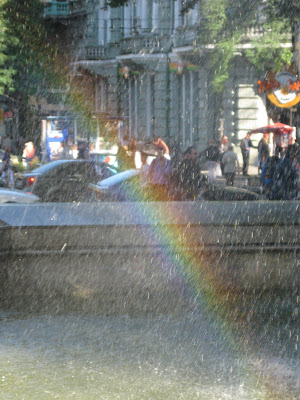
Last but not least: One of many beautiful fountains in Odessa, this one capturing a rainbow. It brought us good weather and good luck in the proud and friendly city of Odessa.

Monday, September 6, 2010

Odessa


The grand curtain of the Opera House dazzles. Jud admires a garden in the City Park. SNACers enjoying Odessa; fantastic ornamental passageway; mother-in-law bridge, with wedding locks, overlooking Black Sea port; grand Opera house inside and out; one of many beautiful fountains; Odessa train station; the orthodox Cathedral across from our hotel.

We senior volunteers had another great SNAC (Senior Volunteers network) meeting in another great city, Odessa. Odessa is a port city on the Black Sea built under orders from Catherine the Great of Russia in the19th century. What a feast! A unique cosmopolitan mix of Russian, Ukrainian, and Mediterranean.

Our Hotel Tsentralnyy, as its name suggests, was well located across from a lovely park and the largest Russian Orthodox church in Odessa. The bells chimed on the hour all day and night. The art and craft show was lovely too.

The city has beautiful architecture, with heavy French andItalian influence. Buildings from the pre-Soviet era, many restored and rehabilitated, have lots of ornamentation, fantastic statuary, intricate wrought iron work, gargoyles and stone carvings. Many of these fantastic decorations, reminders of ancient artisanal traditions and pride of craftsmanship, are around the high ledges above shops and boutiques. Our tour guide Anatoly showed us a stunning example as we took a shortcut between Deribasiva and Preobrazhenskaya streets on our walk toward the Black Sea and the Opera House.

We strolled along tree-lined boulevards and promenades, past statues and fountains, through parks and gardens. We walked over the "mother-in-law" bridge, noted for the hundreds of locks of all sizes and styles left by newlyweds for good luck; past an impressive City Hall; a statue of Russian poet Alexander Pushkin; past the Potyomkinski Skhody, a grand stairway that leads down to the Sea; and on to the stunning Opera House and Ballet Theatre.

Along the way we saw dozens of young couples, just married, dressed in their wedding finery, posing in front of the great statues, fountains and buildings. I've never seen so many beautiful wedding dresses, and high heels worn effortlessly by elegant young women. This is a great Ukrainian tradition, these wedding poses in front of notable buildings and monuments. We volunteers came from all over Ukraine, but we all know this tradition! Odessa was in full wedding swing on this perfect autumn weekend, sunny and bright under clear blue skies. We hoped all this tradition and good weather portended long and happy unions for all the happy couples.

We then did different things around the city, and there's plenty to do. The Jewish museum, archeological museum, and art gallery. Going to the beaches, where many seniors went swimming. Taking a boat ride or cruise along the Sea. For some of us, a highlight of our Odessa trip was a night at the Opera House and Ballet Theatre, one of greatest and most beautiful in the world, a French rococo and gold leaf delight. We all agreed that it ranked right up there with La Scala, the Vienna opera house and, Jud and I thought, the Budapest opera house. We enjoyed a delightful ballet, Paquita, a cornerstone of the traditional classical ballet repertory, according to the program notes, accompanied by a wonderful full orchestra, and after the intermission, a colorful interpretation of Faust, with devils, witches and temptresses galore. It was lovely to be surrounded by such awesome beauty and classical music traditions, in the style of master dancers like Mihail Baryishnikov, Anna Pavlova, Vasyl Njinsky, and Rudolph Nureyev.

A walk through the city at night, full of lights, music, and happy, friendly people, ended our SNAC-filled day. No matter our ages, sites, or experiences, Peace Corps Volunteers know how to have a good time, enjoy each other's company, and embrace the beauty that surrounds us. Odessa was another wonderful Ukrainian adventure.