Thursday, September 16, 2010

Details


Above, Elaborately carved entrance Khan's palace, Bakchysaray; Opulent gilded and painted ceilings with sparkling crystal lights, Khan's palace and Odessa Opera House. Collage: Budapest's Grand bazaar tower and a wrought iron gate; Krakow windows; tile work, Uspensky church, Bakchysaray; Budapest Opera house; Tatar Biblioteca, Simferople, Crimea; entrance to the harem, Khan's palace, Bakchysaray.  Mosaic with elegant surround, Uspensky church.


I used to dislike details. Now I feel just the opposite. I wish I knew then what I know now. It would have saved a lot of grief: those "sharps and flats" of past remembrances, as Mary Oliver calls them. But that was then, this is now, and it's all we have, the Erich Tolle mantra. Today I'm thinking about details.
Details engulf us. There are the details of daily life: What to wear or eat. Who to see or meet. What to do that's neat. There are the details of work life: How to write that grant, where to shelve those books, how to lead that seminar. There are the details of decision-making: Should we cancel the meeting? Add new members to the book team? Ask school teachers to help with that Democracy grant?
And then there are the kinds of details I have come especially to love: architectural details. I am usually overwhelmed by the larger picture. By the grand opera house. The beautiful cathedral. The magnificent legislative hall. The elegant presidential palace. The palaces of Kings and Queens, Khans and Shahs, Emperors and Tsars. I have hundreds of great photos to prove this.
But when I stop and look at the details, then I become engrossed. Not overwhelmed, but engaged. The devil is in the details, they say. I think that's true, and I’ve been bitten hard when ignoring that maxim. Beauty is in the details, too. In everyday details, yes, and most of all in those architectural details. I’m thinking about the craftsmanship, the talent, the patient devotion, the work ethic, the artisanal traditions, the pride.
Take the blue mosaic of a Monk above right. It is from the little Uspensky Cathedral with the glistening golden dome built in the mountain caves of Bakchysaray, Crimea. At the ends of the earth, almost. Who will see it? But some craftsman didn't care about that. Instead he put a lot of work into this lovely mosaic in this far-away place, tile by tile, piece by piece. A master stonecarver chisled the frame around it, also a beautiful piece of artwork. They emerged from contemplation, these details, and they invite contemplation.
Wherever I travel now, I marvel at windows and doors, many intricately tiled, painted, or carved, many surrounded by gargoyles, nympths and angels, birds and leaves, and bas reliefs. And beyond the details of the windows, those in and around buildings; be they homes or palaces, cathedrals or theaters, sacred or profane, the details fascinate.
And it's no wonder. The crafts people of old stayed with their tasks for years. It took ten or 20 or more years for Italian stonecarvers to carve the gargoyles around the National Cathedral in Washington, DC, for instance, chipping away, little by little, day after day,month after month, until a form emerged from stone, from marble, from alabaster. Devils and angels, animals and birds, human and inhuman, symbolic or imaginative, mad, sad, or happy. An award-winning documentary, The Stonecarvers, tells the story (funded by the DC Humanities Council, an NEH affiliate).
It's the same with the stained glass windows of churches, cathedrals, temples and mosques, in the Blue Mosque and in St. Sophia's in Istanbul, St. Andrews church in Kiev, the Kainite Jewish temple and St. Nicolas Cathedral in Yevpatoria. The light that streams through these beautiful windows cast a heavenly glow onto grand spaces. And on top of these, literally and figuratively, hang the ornate and ornamental glass work of crystal lights and chandeliers. Like those lights illuminating beautifully painted ceilings in the photos above. Or the Venetian crystal chandelier adorning the carved mahogany wainscotting in the State room of Livadia Palace in Yalta where Stalin, Roosevelt and Churchill met. I love this tradition, too, the ancient art of glassmaking, foretelling modern American glass artists like Tiffany, Dominic Labino of Toledo and Dale Chihuly of Seattle.
And then there are the exquisite paintings, among my favorite details, covering walls and ceilings, furniture and grand staircases. So rich in detail, so vibrant the colors, so angelic the adorers, so passionate the love scenes. I used to think Michelangelo's awesome paintings at the Vatican were unique to the art world, to religious art especially. And of course they are. But he is not alone. Far from it. He had his predecessors and his successors all over the world. Countless Micheangelos in every country, across the ages, across time and faiths, painted temples, mosques, and churches, in India and in Katmandu, created well before the Renaissance, and also here in Ukraine and in Crimea, in Budapest and Krakow, in magnificent Istanbul, Ancient paintings adorn ancient walls. What glorious gifts to the gods, anywhere, any time, any place.
So here’s to glorious details. My latest toast: “Za Подробнее" [Podrobneyeah, in a rough transliteration]. Here's to tiles, and gargoyles, and ancient lights. Here's to dreamy paintings and heavenly stained glass. Here's to wrought iron railings under starry nights. Here's to intricate marble carvings and mosaic delights.

Wednesday, September 8, 2010

Friends and Beauty in Odessa

Welcome to Odessa! 


WELCOME TO ODESSA!
Here are some more photos of our SNAC meeting in beautiful Odessa. One of my favorites is of an elaborate carved window. What craftsmanship!

Above, the stunning Odessa Opera House and Ballet Theatre. Breathtaking beauty. Gold and light. The majestic chandelair and painted ceiling. Jud and Vickie reading program. We enjoyed classical ballet and a great orchestra (acoustics fantastic).

Next, we are in the Richelieu plaza at the top of the famous Potyomkinski Skhody, a beautiful stairway named after the Russian Imperial battleship Prince Potyomkin, which was stationed at the Odessa seaport in 1905 and supported a workers' uprising. The uprising was squashed, and the mutinous sailors fled to Romania, but the events were made famous by a 1925 film, "Battleship Potyomkin," which I would now like to find and see.

Richelieu by the way, whose statue is at the top of the stairs, was the great grandson of Cardinal Richelieu of France, an early governor of the city under Catherine the Great of Russia. Tour guides say he was responsible for much of the Italian and French architecture of the early city's built environment. It still shines.

Next, new SNAC chair Jim Eleazer (Alaska), PCV with his wife Robin in Ivano-Franko oblast, SW Ukraine, here with our young tour guide Anatoly, as we gather in the hotel lobby. It was a bit like herding cats!

Group photo right,left to right and around: Barbara and Cheryl, working with Tatar communities in Crimea; Debbie is in the South at a university; Ed is in Nikolaiov; Vickie is also in Crimea; and Jim Eleaser, new SNAC chair.

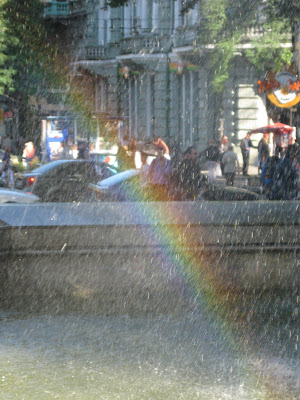
Last but not least: One of many beautiful fountains in Odessa, this one capturing a rainbow. It brought us good weather and good luck in the proud and friendly city of Odessa.

Monday, September 6, 2010

Odessa


The grand curtain of the Opera House dazzles. Jud admires a garden in the City Park. SNACers enjoying Odessa; fantastic ornamental passageway; mother-in-law bridge, with wedding locks, overlooking Black Sea port; grand Opera house inside and out; one of many beautiful fountains; Odessa train station; the orthodox Cathedral across from our hotel.

We senior volunteers had another great SNAC (Senior Volunteers network) meeting in another great city, Odessa. Odessa is a port city on the Black Sea built under orders from Catherine the Great of Russia in the19th century. What a feast! A unique cosmopolitan mix of Russian, Ukrainian, and Mediterranean.

Our Hotel Tsentralnyy, as its name suggests, was well located across from a lovely park and the largest Russian Orthodox church in Odessa. The bells chimed on the hour all day and night. The art and craft show was lovely too.

The city has beautiful architecture, with heavy French andItalian influence. Buildings from the pre-Soviet era, many restored and rehabilitated, have lots of ornamentation, fantastic statuary, intricate wrought iron work, gargoyles and stone carvings. Many of these fantastic decorations, reminders of ancient artisanal traditions and pride of craftsmanship, are around the high ledges above shops and boutiques. Our tour guide Anatoly showed us a stunning example as we took a shortcut between Deribasiva and Preobrazhenskaya streets on our walk toward the Black Sea and the Opera House.

We strolled along tree-lined boulevards and promenades, past statues and fountains, through parks and gardens. We walked over the "mother-in-law" bridge, noted for the hundreds of locks of all sizes and styles left by newlyweds for good luck; past an impressive City Hall; a statue of Russian poet Alexander Pushkin; past the Potyomkinski Skhody, a grand stairway that leads down to the Sea; and on to the stunning Opera House and Ballet Theatre.

Along the way we saw dozens of young couples, just married, dressed in their wedding finery, posing in front of the great statues, fountains and buildings. I've never seen so many beautiful wedding dresses, and high heels worn effortlessly by elegant young women. This is a great Ukrainian tradition, these wedding poses in front of notable buildings and monuments. We volunteers came from all over Ukraine, but we all know this tradition! Odessa was in full wedding swing on this perfect autumn weekend, sunny and bright under clear blue skies. We hoped all this tradition and good weather portended long and happy unions for all the happy couples.

We then did different things around the city, and there's plenty to do. The Jewish museum, archeological museum, and art gallery. Going to the beaches, where many seniors went swimming. Taking a boat ride or cruise along the Sea. For some of us, a highlight of our Odessa trip was a night at the Opera House and Ballet Theatre, one of greatest and most beautiful in the world, a French rococo and gold leaf delight. We all agreed that it ranked right up there with La Scala, the Vienna opera house and, Jud and I thought, the Budapest opera house. We enjoyed a delightful ballet, Paquita, a cornerstone of the traditional classical ballet repertory, according to the program notes, accompanied by a wonderful full orchestra, and after the intermission, a colorful interpretation of Faust, with devils, witches and temptresses galore. It was lovely to be surrounded by such awesome beauty and classical music traditions, in the style of master dancers like Mihail Baryishnikov, Anna Pavlova, Vasyl Njinsky, and Rudolph Nureyev.

A walk through the city at night, full of lights, music, and happy, friendly people, ended our SNAC-filled day. No matter our ages, sites, or experiences, Peace Corps Volunteers know how to have a good time, enjoy each other's company, and embrace the beauty that surrounds us. Odessa was another wonderful Ukrainian adventure.

Wednesday, August 25, 2010

Yevpatoria, Crimea


Street scenes, old town; Turkish restaurant; the Mosque; the Cathedral and lavish interior; Kainite Jewish memorial with prayer room and an engraved tablet.

Yevpatoria, or Evpatoria, is a very special place, like Bakchysaray. It's where the steppes meet the sea, as Barbara put it. No mountains here, but a rich history of different cultures that once made this fabulous Black Sea port their home. I have just learned about a brand new "Black Sea Studies" program at the International Hellenic University in Greece, testifying to the geo-political importance of the area, and after getting a glimpse of this ancient city I am tempted to sign up!

Barbara was a great guide. We wandered into the "old city," where Christian and Orthodox churches, a Muslim mosque, and a Kainite (Kenite) Jewish temple and monument exist near each other, towering over historic homes and restored buildings lovingly decorated and painted.

The Orthodox Cathedral, St. Nicholas, is an opulent building, lavishly decorated with paintings and icons, right up there with St. Mary's in Krakow and the Orthodox churches of Kyiv. Another church, proclaiming "Christ has Risen," stood amidst a lovely garden where Barbara and I sat on a bench and marveled at the sight. The 400-year-old Kahn mosque is elegant but I didn't put on the burka and head dressing necessary to go inside. Memories of Istanbul's Blue Mosque twirled around my head. We heard a Call to Prayer, however, as we toured the Kainite Jewish temple, a contemporary memorial to an ancient nomadic tribe of Turkish descent. I learned that this sect, which I knew nothing about, goes back to the time of Cain and Abel perhaps. It's mentioned in the Old Testament and was apparently spared from the horrors of the Holocaust, I'm not sure why. You walk under a beautiful grape arbor to get to the memorial, which features a prayer room and beautiful marble columns, medallians and tablets engraved with texts from the Torah.

The mixture of religious buildings, ancient homes and streets, and cultural artifacts in this relatively small area of Yevpatoria astonishes. I wanted to know more about how these different cultures and religions came and went, rose and fell. I wanted Loren nearby to tell me more. I think he would have felt at home here himself. I imagined Barbara, Loren and I, having lunch and tea outside at the lovely Turkish Restaurant Jeval.

Yevpartoria, Crimea, an international crossroads: Loren's soul might well reside here.

Yalta and Livadia Palace

Yalta waterfront; Livadia
palace; interiors; vistas.


Going to Yalta from Simferopol on the bus is half the fun and excitement.
Heading into the mountains of southern Crimea is a dream, and I thought for some of the time that we were driving along Route 1 in California. The mountains rose and the sea emerged, the legendary Black sea, a crossroads between East and West for centuries . Barbara said it was "like Yosemite meeting the ocean," it was that beautiful.

And then we arrived in Yalta, a beautiful Russian seaside resort town that has remained a Russian resort town. We walked along the tree-lined boardwalk and pepple (not sandy) beaches, past some Renaissance-like buildings that look like former palaces, lots of health resorts, shops, and souvenir stalls, a busy harbour filled with huge cruise ships from around the world, and sailboats and fishing boats on the shimmering sea's horizon. It was a clear blue-sky day and the whole scene looked like a water-color painting.

A highlight of our visit was seeing the Livadia Palace, where Roosevelt, Churchill and Stalin met to end world War II. It is a long white Renaissance-style palace with a beautiful portico entrance, floor to ceilingl windows, balconies that look out on incredible vistas, large elegant rooms and decorative arts.

The first floor of the palace features the state rooms where the three leaders met for the Yalta conference, including a state reception room surrounded with carved walnut wainscotting and a lovely Venetian glass chandelair floating down from a walnut carved ceiling. For breaks, these world leaders could stroll in anItalian courtyard, or meditate in the smaller but lovely Arabian coutyard decorated with magnificent tiles.

The second floor features the elegant royal rooms of the last Tzar of Russia and his family, all victims of the Communist revolution. A royal study, library, bedrooms, and the children's classroom overlook the most magnificent vistas of

nature, mountains and sea imaginable.

Yalta is sometimes called "The Pearl of Ukraine," but I didn't feel like I was in Ukraine when I was in Crimea. Everything about it is so different from eastern Ukraine, the mixture of pre-historic, Christian, Orthodox, Turkish, Russian, Tatar, and Islamic history, the prosperous looking seasdide towns, the ancient names and places of mixed ancestry.

I'm told the majority of people in Crimea remains firecely loyal to Russia, while the indigenous people, the Crimean Tatars, who were forcibly removed from their homeland by Stalin and the Soviets, view the Soviets as intruders and oppressors. The Crimean Tatars live with the pain of a well-organized Soviet army-enforced deportation on the evening of 18 May 1944. Some 47% of the rsesettled population died of disease and malnutrition during the deportation. Crimean Tatars are now returning to their homeland after over sixty years in exile, many from Uzbekistan and Turkey. Sometimes the tension is palpable, and sometimes it is lost in the beauty and serenity that engulfs Crimea.

Returning Crimean Tatars have lots of stories to tell. The pain of losing their land remains, along with fervent efforts to preserve their language and culture. Would an ordinary but ancient pair of forged iron tongs mean anything to most of us? Probably not. But to one family it is all that remains of parents, grandparents and other relatives forced to flee their homes in a hurry one dark night in 1944, grabbing whatever they could in a state of shock and panic, a pair a tongs, a symbol of the sorrow of forced removal from ancestral homes.

Crimea has a complex past and present under its magnificent exterior. But Yalta remains a shining star.

Sunday, August 22, 2010

Bakhchysaray and Chufut-Kale


Barbara at the caves; the cave city Chufat-Kale; the Khans' palace with minaret and entrance to small mosque; and the Uspensky monestary.


Bakchysaray, which means "garden palace" in Turkish, was once the capital of the powerful Crimean Khanate between the 15th and 18th centuries. After decades of tragic destruction
from both the Russian Tzars and then the Soviets, the town and its treasures are coming back to life.


The Khans' original palace survives, supposedly
because Catherine the Great thought it was
"romantic and sweet," which it is. The

palace was built by slaves under the direction of Ottoman, Persian and Italian architects. This would be a fantastic story to research and study. It's noted for its intricate designs and gates, its lovely mosque and minarets, its pretty harem, its wall paintings and decorations, and beautiful courtyard. The "Fountain of Tears," erected by master Omer in 1764 to honor his daughter, moved famous Russian poet A.S. Pushkin to write his poem "The Bakchyrsaray Fountain" in the 1820s.

Nearby is the lovely Uspensky Monestary, built into the rocks, probably by Byzantine monks in the 8th or 9th century. The gold-domed church, whitewashed and tiled, shines like a bright star on the hillside. The Soviets closed the church down, but it opened once again in 1993 and is maintained by local monks.

The most fantastic hike is through the old cave city of Chufat-Kale, fortified both by nature and man. It is a complex series of caves and structures (sheds, homes and barns) built into the limestone rock, which provided a fortress and refuge for different groups of migrants for hundreds of years. The views of the valley below are breathtaking. The guidebook Barbara has said it was first settled by Christian descendants of Samarian tribes, then around 1390s by the Crimean Tatars, and after the Tatars dispersed, by a dissident Jewish sect, the Kainite Turkish Jews, until about the mid-19th century. This sect of Judaism gave the mountain its current name, Chufut-Kale.

Wow, if these hills could talk. Scholars have tried to listen; lots of archeologists, for example, have explored the caves and tried to reconstruct their complex history. It's certainly a scholarly feast. But I think my brother Loren could tell me more than any guidebook or scholarly studies. He knew this history and I wish he were here to tell me.

Bakchysaray is a fascinating part of Crimea, and the planet, a place where old civilizations sought refuge and moved mountains, and modern generations are moved to understand them.

Saturday, August 21, 2010

Crimea, Tartars and Bakhchysaray

Barbara (with my luggage!) in front of the
Crimean Tartar Library; a lovely archway at the Library; a taste of Smferople.


I’m in Simferople, Crimea, visiting my PCV friend Barbara, who lives and works with the Crimean Tartar community. Simferople is a city of about 345,000, which feels huge coming from Starobilsk. Barbara lives in a neighborhod repopulated by returning Tartars who were kicked out of their Crimean homeland by Stalin in 1944. Here’s how she describes the community (www.crimeantartarlibrary.blogspot.com):

The Crimean Tatars are a Turkic Muslim people who inhabited the Crimean Peninsula—the southern land mass of Ukraine surrounded by the Black Sea and Sea of Asov—for over seven centuries. For three hundred years, from 1441 t

o 1783 when Crimea was annexed by Russia, the Crimean Tatars ruled the peninsula through the Crimean Khanate. At the height of the Crimean Khanate, there were over six million Crimean Tatars inhabiting the peninsula, and at the time of annexation to Russia, they constituted 98% of the population. The intense Russification of the peninsula over the next century forced many Crimean Tatars to leave their homeland, and by the time of the Russian Revolution, there were only 300,000 Crimean Tatars left on the peninsula. Under the Bolsheviks a brief flowering of Crimean Tatar culture occurred between 1921 and 1927, and Crimean Tatar was made the official language of the peninsula along with Russian.

Stalin’s repressive policies soon ended this “Golden Age” and resulted in further devastation of the Crimean Tatar people and culture, culminating in the mass overnight deportation on May 18, 1944, of all Crimean Tatars to Uzbekistan and other distant Soviet Republics. Over 46% of the Crimean Tatar population died during transport and in the subsequent camps, and almost all evidence of Crimean Tatar culture—mosques, place names, art and literature—were destroyed in Crimea, leading to the desired final solution of a “Crimea without Crimean Tatars.”

Still, the Crimean Tatars--living in exile, not allowed to speak or teach their language, practice their religion, play their music, or write their stories--kept alive the dream of their homeland and formed a national movement which, after fifty years of nonviolent struggle, brought them back to their native land of Crimea. The Crimean Tatars slowly began to return in1985, a momentum that gathered strength as more and more restrictions were lifted, and in a 4-year period from 1989 to 1993, over 200,000 Crimean Tatars flooded back to Crimea. Today, an estimated 300,000 Crimean Tatars live in Crimea, constituting 13% of the population. They have an official governing body, representatives in the Crimea and Ukraine Rada (Congress), national schools that teach all subjects in Crimean Tatar, a university that educates Crimean Tatar language teachers, art and history museums, theater, radio and TV stations, and the Gasprinskiy Crimean Tatar Library where I so happily find myself working as a Peace Corps Volunteer.

For an excellent English-language website on the history and culture of the Crimean Tartars go to www.iccrimea.org.

The Gasprinskiy Crimean Tartar Library, named after a major turn-of-the-20th century Tartar writer who was far ahead of his time, is a major institution for this community, working to preserve the language and culture of the Tartar people. Barbara continues:

As Crimean Tatars flooded back to their homeland in the late 1980s and early 1990s, they began to establish organizations to serve their returning people. In 1990, the Crimean Tatar Library in the name of I. Gasprinskiy (known as the Gasprinskiy Library) opened as a branch of the central library system in Simferopol, the capitol of the Autonomous Republic of Crimea in Ukraine. Five years later, it became an autonomous library under the Ministry of Culture in Crimea.

The mission of the library is to acquire, store, and make available to users the world’s largest collection of documents in the Crimean Tatar language and about Crimean Tatars in other languages. Today, the library has a collection of more than 32,000 books plus 9000 complete sets of magazines and newspapers in the Crimean Tatar language; 4500 books in Turkish and other Turkic languages; and more than 2000 rare and valuable books.

Being with Barbara in Simferople is an adventure in itself, meeting her neighbors, sharing meals, and visiting the library.

On Saturday we went to the fabulous town of Bakhchysaray and visited the Khan’s palace, a building spared when Catherine the Great of Russia ordered the destruction of Crimean mosques, because it was a romantic and lovely structure, which it is; the Uspensky monastery, built into the limestone rock of the surrounding hill, most probably by Byzentine monks in the 8th or 9th century; and Chufut-Kale, one the best preserved and best-known cave towns of Crimea. Loren would have absolutely loved this area, and I got a feeling it may have been near or around the site of The Clan of the Cave Bear and other stories by Auel. Quite a hike, but well worth the effort to explore this fascinating place. More about Bakhchysaray later!